
Training load
Spot who is overloaded before they get hurt, with sRPE, ACWR, monotony, strain
get a live demo


What does it do?
Training load is the base of injury prevention: you can’t manage what you do not measure. SquadStats turns each session into a number and compares it with the past weeks. It lets your staff:
- Collect sRPE after each session
- Compare acute load against chronic
- Spot who ramps up too fast, or too little
- Check monotony and strain (Foster) on a 7-day window
- Track minutes per player to manage the rotations
The better you measure the load, the fewer surprises on the injury list, for the player and for the team.
How Load Connects to Readiness
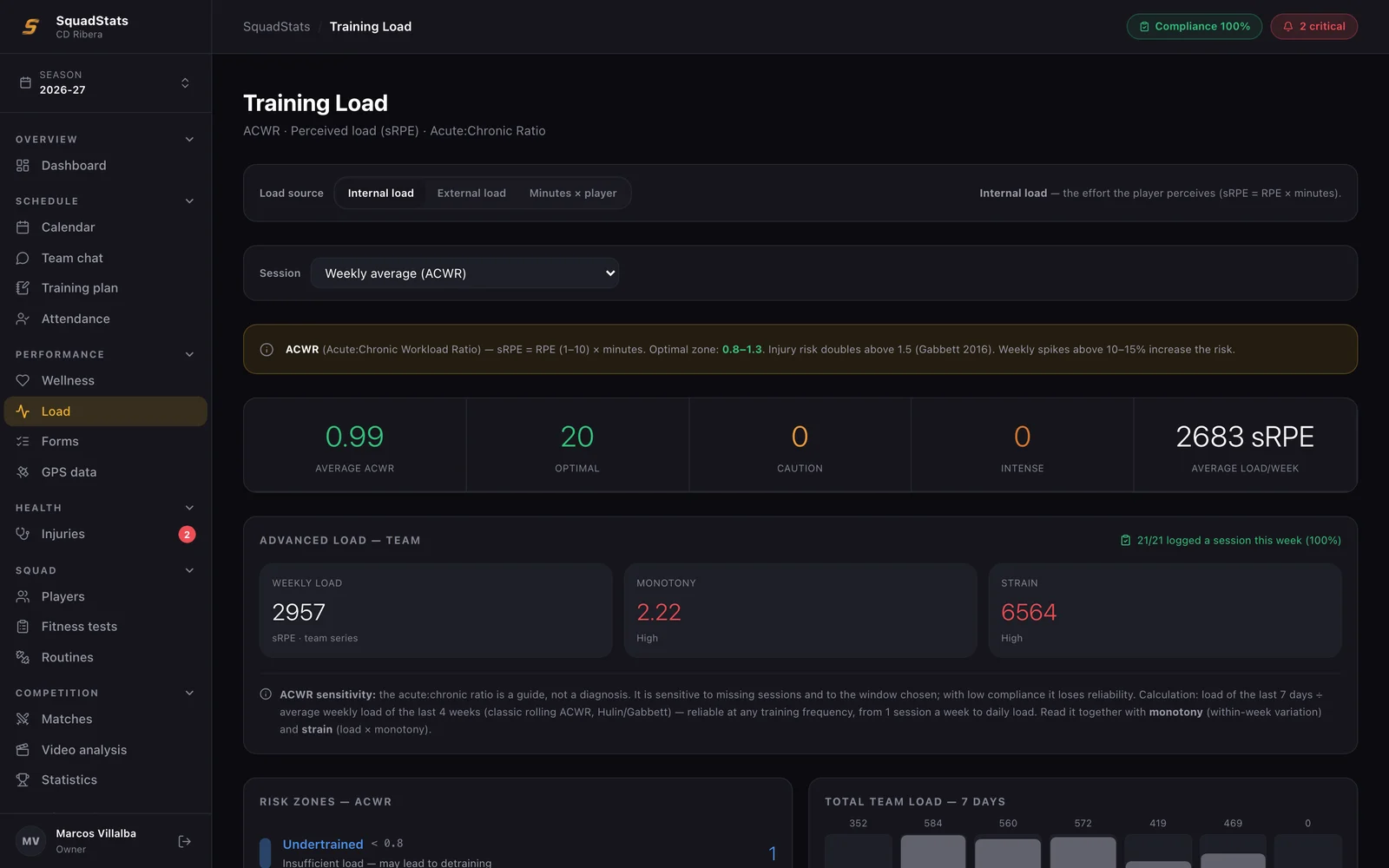
ACWR feeds the player’s readiness 0–100: above 1.5 it takes 20 points off, above 1.3 it takes 10 and below 0.8 it takes 5. The overload shows up on the dashboard and in the alerts on its own, and the staff adjusts the next session before the risk turns into an injury.
sRPE base
The base input is sRPE (Foster’s method): after training, each player gives their RPE from 1 to 10 and the minutes, and sRPE = RPE × minutes. ACWR compares how much you loaded this week against your own average of the last month: ramp up too fast and it flags risk; load too little and it flags undertraining. Every zone says what to do.
Two ways
Both methods coexist: the rolling ACWR and the “uncoupled” EWMA ACWR (Williams and Lazarus), which weights recent days more heavily and corrects the coupling bias. Zones follow Gabbett: below 0.8 undertrained, 0.8 to 1.3 optimal, up to 1.5 caution and above 1.5 danger, with guidance.
Monotony and strain (Foster) close the picture on a 7-day window: monotony is the daily mean divided by its standard deviation, and strain is the weekly load times monotony. A week where all days look the same is a warning too, even when the total weekly load looks perfectly reasonable at first sight, too.
ACWR is a guide, not a diagnosis: it needs about four weeks of history before the chronic term becomes truly representative for every player.
What changes for you
Most soft-tissue injuries come from load that grew too fast, and almost nobody sees it coming from a spreadsheet. Training load puts sRPE, ACWR, monotony, strain and minutes per player on one panel, with the maths in plain sight and every zone explaining what it means and what to do, so you plan the next week with data instead of feel. Book a demo and see it working with your actual squad and all your own data.
Other tools

BOOK DEMO TODAY
WE ONBOARD YOUR STAFF
Request a demo and our team will set up SquadStats with your real squad: temporary access, hands-on onboarding, and a proposal built for your club.


